Total Pageviews

Thursday, June 6, 2013

Lenovo K900

with 2GHz processor, Android 4.2, 13 MP camera launched for Rs 33K


The Chinese smartphone/ PC company, Lenovo, has launched K900 with 2GHz processor, Android 4.2, 13 MP camera in India for Rs 33K
Lenovo, the Chinese smartphone and computer manufacturer has arrived in India in the smartphone market after almost taking over India’s laptop market. Though not many people are aware about its image as one of the best and biggest smartphone manufacturer back home, analysts know that the company comes with long and well deserved history and is going to win millions of fan followings in the market.
I am amazed at the delayed launch or arrival of the company in the smartphone market. I am more amazed because of the fact that despite having infrastructural presence in almost every part of the country, the Chinese tech giant delayed its launch till now. But I think that company was not very enthusiastic about its entry in the smartphone market as the market was still in its infancy and it might have thought it waste of resources to invest hundreds of millions of dollars. But as the smartphone market is saturating in China and the fact that Indian smartphone market is growing at fast pace right now, this was the most opportune time to come here and get a market traction by offering great handsets at comparably lower price.
The company has come out with 6 handsets and to be true the least pricey of them comes for around Rs 8000 while the costliest comes at Rs 33000. So the company is looking forward to have something to offer to every group of people looking for different types of handset. So it has an entry level rather good handset, several mid range smart phones and then handset that comes with top specifications and features. Nonetheless, despite coming with so many products and at prices that look affordable compared to Samsung and HTC handsets, the Chinese company will have to work really hard to attract people to its handsets. There are many smartphone vendors here and so many handsets in all the categories that it is going to be a tough task for a new company to make an impact.
Lenovo K900 is as good if not better than Korean tech giant Samsung’s Galaxy S4 and comes at least Rs 8000 cheaper than S4. The best handset that the company is launching in India is K900 that is priced at Rs 33000. And without doubt it comes with best specifications. The 5.5-inch 440+ ppi screen hides a 2.0GHz dual-core Intel processor and 2GB of RAM, with a 13MP camera (including a Sony Exmor lens) around the back. It’s all tied together with Android 4.2 inside a nice metal chassis. So it is very impressive without doubt. The highlight of P780 is high-capacity 4000 mAh battery while the A706 has the Dolby Digital Plus technology for better audio experience.
Other handsets that are equally enticing for different segments and are priced very reasonably include P780. This handset is aimed at professionals and executives. P780 comes with 1.4 GHz quad core processor along with a 4000 mAh battery. Another equally good handset is S920 that comes with a massive 5.3-inch IPS display, 8 mega pixel camera and a 1.2GHz quad core processor. Other handsets too are great and may attract significant number of buyers.

Thursday, May 30, 2013

GIGABYTE GTX 770 WindForce

Pictures of the GIGABYTE GeForce GTX 770 have shown up online, thanks to GIGABYTE. The company jumped the gun and posted up a product page for its upcoming GTX 770 WindForce video card. We've seen some leaks regarding the GTX 770, but nothing official has been provided by NVIDIA.
gigabyte_gtx_770_windforce_shows_up_on_gigabyte_s_own_website_shouldn_t_be_too_long_until_it_launchesgigabyte_gtx_770_windforce_shows_up_on_gigabyte_s_own_website_shouldn_t_be_too_long_until_it_launches
The specs are basically what we saw earlier today with a previous leak. The WindForce makes use of GIGABYTE's WindForce 3X 450W cooling system and features 2GB of GDDR5 RAM connected on a 256-bit memory interface. The clock is slightly higher than the previous leak, comking in at 1137MHz base and 1189MHz boost.

For now, the page is still visible over on GIGABYTE's page, though it could end up being pulled down soon. With product pages being put up, it shouldn't be too much longer until the card is officially available.

Tuesday, May 28, 2013

Sony’s Waterproof Tablet

Pre-order @ Rs 44,990

NEW DELHI: Sony Xperia Tablet Z, unveiled at Consumer Electronics Show 2013 in US, is now available for pre-order in India. Major online retailers are taking advance bookings for the device, which is scheduled to be launched early next month. FlipkartSnapdeal and Infibeamare offering the device with 16GB storage andWi-Fi and 3G connectivity for Rs 44,990 approximately. 

Xperia Tablet Z runs on Android 4.1 (Jelly Bean) out-of-the-box and has waistline of just 6.9mm, thinner than that of rivals like Apple iPad and Google Nexus 10. Another key feature is its shockproof, dust resistant and waterproof body, which makes it largely impervious to damage. 

The all-new Xperia Tablet Z by Sony features a 10.1-inch TFT touchscreen with Mobile Bravia Engine 2 display technology and image resolution of 1920x1200p. It is powered by a 1.5GHz quad-core processor, coupled with 2GB RAM, and 32GB onboard storage, with microSD support of up to 32GB. The tablet has an 8.1MP camera with Exmor R imaging technology and LED flash on the back, a feature no other rival can match as of now. 

Connectivity suite of Xperia Tablet Z includes top notch features like 4G LTE as well as NFC, along with standard options like 2G, 3G, Wi-Fi, Bluetooth 4.0 and microUSB. Powered by a 6,000mAh battery, the device will be available in black and white colours. Sony has also included its proprietary S-Force virtual surround sound technology in the tablet for enhanced audio quality. 

This is the third tablet by Sony, after Xperia Tablet S and Xperia Tablet P, which failed to make their mark in the market.

Xbox One vs. PS4 vs. PC

How the hardware specs compare


Xbox One vs. PS4

With just two weeks until E3, Microsoft has finally shown off the Xbox One. Unlike Sony, which is being very mysterious with its PS4, we now have a fairly good idea of the hardware inside the Xbox One. This isn’t to say that we know everything about the Xbox One, but, as with the PS4, we know enough to corroborate the specs that have leaked over the last few months. We can now say with some certainty that the Xbox One and PS4 are powered by very similar hardware: The CPUs are probably identical, the GPUs are only slightly different, and while there are underlying differences to the memory subsystem, they will ultimately have very similar performance and game visuals. For a detailed discussion of how the PS4′s hardware compares to the Xbox One and gaming PCs, read on.
From Microsoft’s mouth, we know that the Xbox One (formerly known as the Xbox 720) has an 8-core AMD CPU with 8GB of DDR3 RAM, a 500GB hard drive, HDMI in/out, USB 3.0, and Gigabit Ethernet. For more detailed specs, we must look towards the latest info from the games development sector, which has been programming Xbox One games since last year and thus has intimate knowledge of the hardware. The latest leaks suggest that the Xbox One will have an 8-core 64-bit x86 Jaguar AMD CPU @ 1.6GHz, coupled with a GPU that’s very close to the Radeon HD 7790. The Xbox One will have 68GB/sec of bandwidth between the CPU/GPU and RAM, the GPU will have 102GB/s of bandwidth to a local 32MB SRAM cache, and another 30GB/s of bandwidth to gamepads, Kinect, and other peripherals.
Xbox One hardware diagram, including ports
Xbox One hardware diagram. Note the ports on the back.
The PS4, in comparison, has an 8-core Jaguar AMD CPU, with a GPU that’s around the same level as the Radeon 7870 (which is significantly more powerful than the 7790). The PS4 has 8GB of GDDR5 RAM, providing 176GB/s of bandwidth to both the CPU and GPU. The Xbox One mostly ameliorates this difference with 32MB of high-speed SRAM on the GPU, but it will be a more complex architecture to take advantage of.
In both consoles, the CPU and GPU will be on the same die (an AMD APU). Just as the PS4 has 8GB of high-speed memory that is shared by the CPU and GPU, the Xbox One – by virtue of being based on the same APU heterogeneous system architecture (HSA) — will probably be the same. In short, while there are small hardware differences between the consoles, they will ultimately have very similar performance characteristics. The PS4, with its one, big block of fast RAM, and bigger GPU, probably has the edge.
It’s a little bit harder to compare the Xbox One’s Kinect 2.0 with the PlayStation 4 Eye. From what we know so far, the Xbox One sounds like it has the edge on movement tracking and gesture controls. We should know more at E3, when Sony finally reveals a few more details about the PlayStation 4 Eye.
PS4 DualShock 4 controller
Finally, the last piece of hardware that we can compare between the Xbox One and PS4 is the gamepad. As we have already covered in some detail, the PS4′s DualShock 4 controller is really quite spectacular. There’s built-in movement tracking, so the console can track who’s holding each controller, a built-in speaker (like the Wiimote), and a multitouch touchpad. The Xbox One gamepad, in comparison, is basically just a refined version of the Xbox 360 gamepad. The only new feature seems to be Impulse Triggers — which are normal triggers, but with a rumble function built in. The PS4 controller definitely seems to have a richer feature set, but in practice the most important thing will be which controller you prefer to hold.
In comparison to a modern PC, you can probably guess how the Xbox One and PS4 compare. There’s no direct comparison for the 8-core Jaguar CPU — AMD’s own parts based on the Jaguar core, Kabini and Temash, are quad-core parts destined for ultrathins and tablets. From leaked benchmarks, the Jaguar core is around 10% faster than its predecessor (Bobcat). A dual-core Brazos (Bobcat core) about 10 times slower than the latest Ivy Bridge parts, in a very naive comparison. So, all in all, an 8-core Jaguar might manage about half the performance of a current-gen Core i7. The GPU comparison is easier: The Radeon 7790 is a $150 card.
In short, then, today’s PCs will stomp all over the Xbox One (and PS4) in terms of raw computation power. In terms of gamepads and other peripherals, the Kinect 2.0 will also come to the PC (though Microsoft hasn’t given a timeline yet) — and, presumably, as with the Xbox 360, you should be able to use the Xbox One gamepad with your PC. With some hacking, you should be able to use the PS4′s gamepad with your PC, too.

Xbox 720/One hardware

It’s not how big it is; it’s what you do with it

Another way of looking at the Xbox One and PS4, though, is their power relative to their predecessors. In terms of raw, synthetic performance, the Xbox 360 could churn out around 300 gigaflops; the PS3 was around 400 gigaflops. The Xbox One and PS4, however, should both be above two teraflops — about six times more powerful than their predecessors. Remember, the output resolution (1920×1080) is unlikely to change — so, with six times more power, we’re looking at a significant improvement to image quality.
Using teraflops as a stand-in for real-world performance, though, to quote our hardware analyst Joel Hruska, is like “giving the fuel efficiency of a car going downhill with an 80 mph tailwind on helium-inflated tires.” What it ultimately comes down to is how efficiently developers use the hardware — and in that regard, we have high hopes. With the shift to x86, and a GPU architecture (AMD’s GCN) that’s well known, developers will be able to hit the ground running. Compare this to the Cell CPUs at the heart of the Xbox 360 and PS3, which took years for developers to fully understand.
It’s also important to remember that, in recent years, there has been a fundamental shift away from games that do the bulk of their computation on the CPU, to programs that use the CPU to offload computation to the (much more powerful) GPU. With the Xbox 360 and PS3, both consoles had a monstrous Cell-based CPU and an equally large GPU — the PS4 and Xbox One, on the other hand, have wimpy, many-core CPUs and much larger GPUs. With both consoles moving to fill more of a media center/set-top box role, rather than focusing on gaming, we can foresee those cores being dedicated to background tasks, such as downloading updates or listening for voice commands. Ultimately, this will come down to the software — and while we have quite a few details on the Xbox One’s software, we know almost nothing about the PS4.
Ultimately, with both the Xbox One and PS4 having such similar hardware, real-world performance differences will probably come down to how well the consoles make use of those eight CPU cores, GPU offloading, and differences in the memory subsystem. It’s also important to bear in mind that a huge speed-up is available when developing games for a fixed platform with known performance/latency characteristics. Realistically, we wouldn’t be surprised if games on the Xbox 720 and PS4, just like the current generation, look very similar. Likewise, games will probably look better on consoles for a few years, and then PCs will probably pull back ahead.

Wednesday, April 24, 2013

AMD Radeon HD 7990

Blazes Onto the Gaming Scene

  AMD Radeon HD 7990

It's springtime, and after you take notice of the cicada brood and cherry blossoms in the real world, AMD would like you to get back into your den and see the detail and smooth animation in the virtual world.

Today, AMD released details about its new flagship graphics card, the AMD Radeon HD 7990. It's touted as the world's fastest graphics card, and is designed for the PC gamer who wants to play high-end 3D games at the highest resolution on a massive high-resolution panel or spanning multiple displays.

The AMD Radeon HD 7990 is built on the platform formerly known as Malta, and it is a dual-socket, dual-GPU card with 8.6 billion transistors, 4096 stream processors, and 8.2 TeraFLOPs of compute power. The Radeon HD 7990 comes with 6GB of GDDR5 graphics memory (3GB per GPU), and can support up to five simultaneous monitors with AMD's Eyefinity technology. It can do this via a single dual-link DVI port and four mini DisplayPorts. AMD's version of the card will come with a massive card-spanning heatsink and three cooling fans. AMD claims that its card is quieter than the Nvidia GeForce Titan and GeForce GTX 690 while running benchmark tests. The individual GPUs can also enter a power saving mode, helping keep your PC quiet and cool.

The raison d'ĂȘtre for an enthusiast gaming board is to play games, and the Radeon HD 7990 comes bundled with eight high-profile titles. All AMD Radeon HD 7990 buyers will get copies of BioShock Infinite, Tomb Raider, Crysis 3, Far Cry 3, Far Cry 3 Blood Dragon, Hitman Absolution, Sleeping Dogs and Deus Ex Human Revolution. In particular, AMD claims that you will be able to play Crysis 3 and Tomb Raider at 4k resolution (3,840 by 2,160) with all the eye candy turned on.
The AMD Radeon HD 7990 will also be available from third party partners like Asus, Sapphire, and XFX. AMD's Radeon HD 7990 SEP bundle has a $999 MSRP, and will be available after Wednesday, May 8th, 2013.


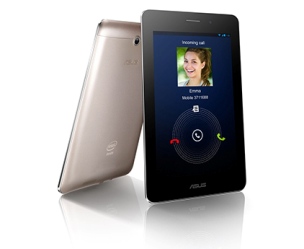
Asus 3G


7-inch FonePad with Intel Atom Z2420 processor


Keeping in mind the growing popularity for tablets in India Asus is coming out with another 7-inch FonePad in for Indian customers with 3G mobile data after launching  after launchingAsus Nexus 7 3G recently. 

Asus Fonepad was launched at Mobile World Congress in February, and is priced at S$369 in Singapore when it makes debut in a couple of days. Its price in India has not been revealed. The Device has also been launched in Malaysia and Taiwan.

The device has a 7-inch display with a resolution of 1280×800 pixels and runs on Android v4.1 OS (Jelly Bean). It is powered by Intel Atom Z2420 processor with 1.2GHz CPU speed and sports 1.2-megapixel front facing camera & 3.15-megapixel rear camera.

It comes with 4,270-mAh battery and 1GB RAM with 8GB and 16GB.memeory which is  extendable 32GB.
Early this month, Asus had launched its Google Nexus 7 tablet with its 7” display for the Indian market. Nexus 7 is powered by the NVIDIA Tegra 3 processor, and Jellybean OS.
The Asus Nexus 7 3G version will be available in India for Rs. 21,999 and Wi-Fi variant would be available in India for Rs. 18,999.

Tuesday, April 23, 2013

Top five Android tablets in India

Indian market is flooded with Android tablets, but it is still very hard to find a quality tablet. So, we have compiled a list of five best Android tablets that you can consider for your next tablet purchase.  Nexus 7 and Samsung Galaxy Tab 2

Apart from the Chinese rebranded tablets that are present in the country, there are hardly any other choices, but the recent few launches from Asus including Nexus 7, have made the market dynamics interesting. Samsung continues to be present everywhere and provides decent and feature-rich tablets.
Following is our list of best five Android tablets available in the country.

Nexus 7

Made by Asus in partnership with Google, Nexus 7 continues to be one of the most popular Android tablets worldwide. The tablet was recently launched in India, first by Google in Play Store, then by Asus in the retail market. With the excellent design, latest Android version and attractive pricing, Nexus 7 is a no-brainer for many; however with the impending launch of Nexus 7 successor in around 50-60 days, you might want to wait.  We will still recommend Nexus 7 as there is no surety on when Google or Asus will release Nexus 7 II in India.
Prices:
  • Nexus 7 16GB Wi-Fi only version – INR 15,999
  • Nexus 7 32GB Wi-Fi only version – INR 18,999
  • Nexus 7 32GB 3G+ Wi-Fi version – INR 21,999

Samsung Galaxy Tab 2 7.0 (Samsung Galaxy Tab 2 310, Tab 2 311)

This seven-inch Android tablet from Samsung has been the most popular tablet in the country. First launched as 3G plus Wi-Fi version, it was joined by Wi-Fi only version a few weeks ago. It might not have the quad-core processor like Nexus 7, but thanks to a more attractive pricing, it is great option in its own way.
Prices:
  • Samsung Galaxy Tab 2 310 with 3G+Wi-Fi – INR 16,499
  • Samsung Galaxy Tab 2 311 with Wi-Fi – INR 12,899 (INR 10,499 on Flipkart)

Samsung Galaxy Note 800

Looking for a ten-inch Android tablet, you should consider Samsung Galaxy Note 800. Packed with impressive specifications and S-Pen stylus, it is probably your best option for a 10-inch tablet in the country. It might not have a great build quality, but software customisations like multi-window will make multi-tasking even easier for you.
Price:
  • Samsung Galaxy Note 800 3G+Wi-Fi – INR 35,190

Acer Iconia B1

Nexus 7 and Samsung tablets are a little out of your budget; don’t worry. Acer Iconia B1 is great option for seven-inch tablet enthusiasts, who don’t want to spend too much on a tablet purchase. Packed with nice features and brand credibility, it is certainly a better option than the Chinese tablets available for lower prices.
Price:
  • Acer Iconia Tab B1 Wi-Fi only – INR 7,999

Asus Memo Pad

Following the launch of Acer Iconia B1, Asus also jumped in the budget tablet segment. Memo Pad takes cue from Nexus 7’s excellent build quality, thus it is one of the best made budget tablets that you can find in the market. The specifications might not be earth-shattering, but I would still recommend it over rebranded options available in the country. You can always spend 6K more and get yourself a Nexus 7 tablet.
Price:
  • Asus Memo Pad Wi-Fi only- INR 9,999